


Finding the nub on your 12-week scan can feel confusing, but knowing where to look makes all the difference. This expert guide breaks down exactly what the nub is, where to locate it on your ultrasound image, and how nub theory works for early gender prediction. Whether you're analyzing your scan yourself or using an AI-powered tool, we've got you covered.
Where Is the Nub on a 12-Week Scan? Your Questions Answered
If you've just received your first trimester ultrasound and found yourself squinting at the image wondering where is the nub on a 12-week scan, you're far from alone. Thousands of expectant parents ask this same question every day — and for good reason. The nub is tiny, the images can be blurry, and unless you know exactly what you're looking for, it's easy to miss entirely.
This FAQ guide is designed to give you clear, expert answers to the most common questions about nub theory, nub location, and early gender prediction from your 12-week ultrasound. Whether you're a first-time parent or a seasoned scan-analyser, you'll find everything you need here.
What you'll learn in this guide:
- Exactly where the nub is located on a 12-week ultrasound image
- What the nub looks like and how to distinguish it from other structures
- How nub angle predicts gender — and how accurate it really is
- How AI tools like NubScan can take the guesswork out of reading your scan
Nub theory has been around for decades, but it's only recently — thanks to better imaging technology and AI-assisted analysis — that parents have been able to access reliable early gender predictions before their 20-week anatomy scan. Read on to get the full picture.
What Does the Nub Actually Look Like — and Where Do You Find It?
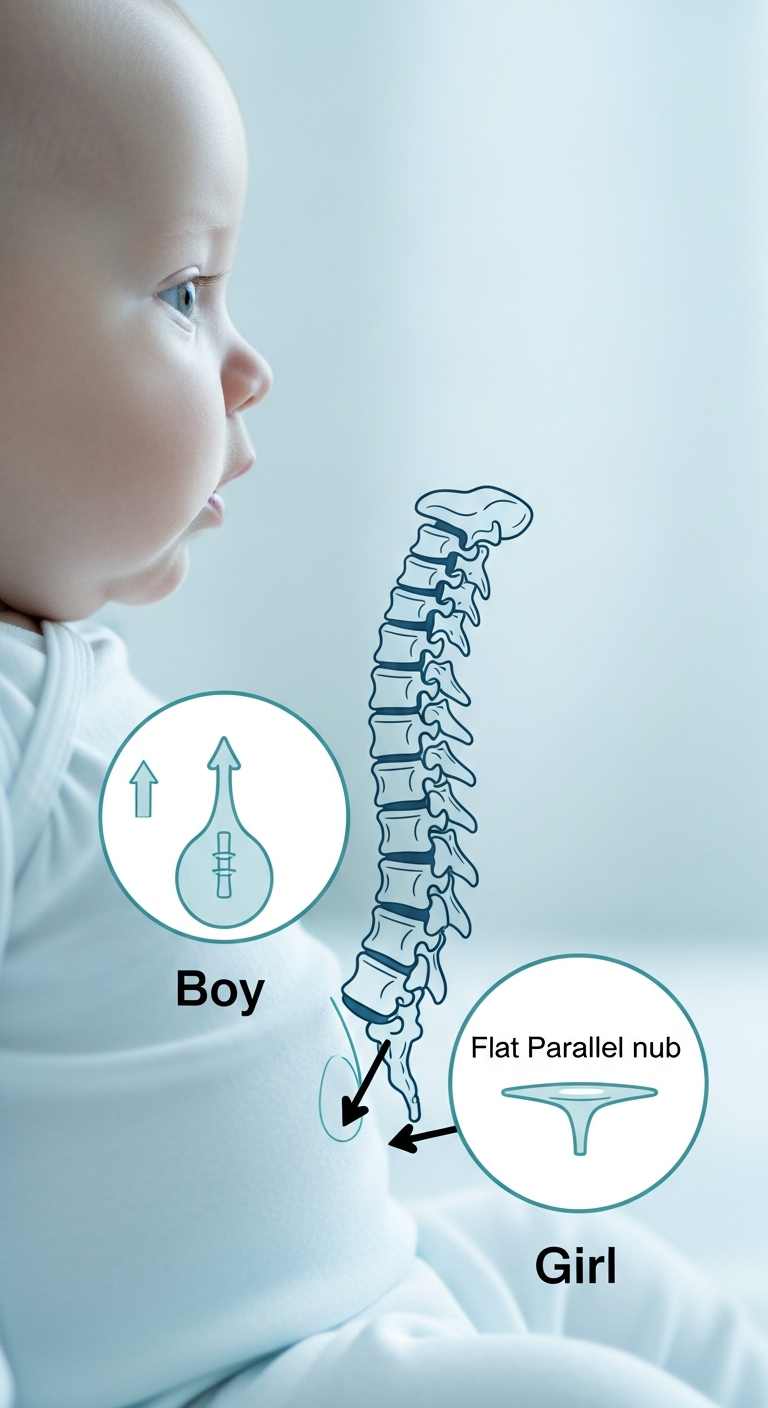
Understanding where the nub is on a 12-week scan starts with knowing what you're actually looking for. The nub — formally called the genital tubercle — is a small, bud-like projection that sits at the base of your baby's spine, between the legs. At 12 weeks, it's only a few millimetres long, which is why so many parents struggle to spot it without guidance.
The Key: You Need a Sagittal View
The single most important factor in locating the nub is scan orientation. You can only reliably identify the nub in a sagittal (side profile) view — meaning the baby must be lying on its side, with the spine visible along the top or bottom of the image. If your scan shows the baby face-on or from above, the nub simply won't be visible.
In a proper sagittal view, here's what to look for:
- Trace the spine downward from the baby's head toward the bottom of the image
- At the very end of the spine (near the tailbone area), look for a small protrusion sticking outward
- This protrusion — often appearing as a tiny sliver or spike — is the genital tubercle (the nub)
- It may point upward at an angle or run parallel and flat along the spine
Why Angle Is Everything
Once you've found the nub, the next step is assessing its angle relative to the spine. This is the core principle behind nub theory:
- Angle greater than 30° (pointing upward) → typically indicates a boy
- Angle parallel or less than 30° (flat or slightly raised) → typically indicates a girl
It sounds straightforward, but in practice the difference between a 28° and a 32° angle can be genuinely hard to judge with the naked eye — especially on a standard printout. That's why many parents turn to nub theory examples with annotated ultrasound images to sharpen their interpretation skills before analysing their own scan.
What Can Make the Nub Hard to Spot?
Several factors can obscure the nub even on a high-quality 12-week scan:
- Fetal positioning — if the baby isn't in a perfect side-on position, the nub won't be visible
- Image resolution — low-quality or heavily compressed scan photos reduce detail
- The umbilical cord — it can sometimes overlap the nub area and cause confusion
- Gestational age — earlier than 11 weeks, the nub is too undifferentiated to angle correctly
If you're unsure whether your scan shows a clear enough sagittal view for nub analysis, it's worth understanding how nub theory compares to other early prediction methods — our guide on nub theory vs skull theory breaks down which approach works best depending on your scan type and image quality.
The bottom line: finding the nub requires the right image angle, a trained eye, and ideally a tool that can measure the angle objectively. When all three come together, nub theory becomes a remarkably powerful early gender prediction method.
How Quickly Can You Get Nub Theory Results From a 12-Week Scan?

One of the most common follow-up questions after learning where the nub is on a 12-week scan is: how long does it actually take to get a result? The answer depends on the method you choose — and the difference can be significant.
Option 1: DIY Analysis (Your Timeline Varies)
If you decide to locate and interpret the nub yourself, the process can take anywhere from a few minutes to several hours. Here's why:
- You first need to confirm your scan is in the correct sagittal orientation — this alone can take time if you're unfamiliar with ultrasound images
- Locating the nub at the base of the spine requires patience, especially on lower-resolution printouts
- Measuring the angle by eye — or using a protractor tool on a digital image — adds extra steps
- Many parents spend time cross-referencing their scan against annotated nub theory examples before feeling confident in their reading
For first-timers especially, self-analysis is rarely quick. And even after putting in the time, uncertainty often remains.
Option 2: AI-Powered Analysis With NubScan (Seconds)
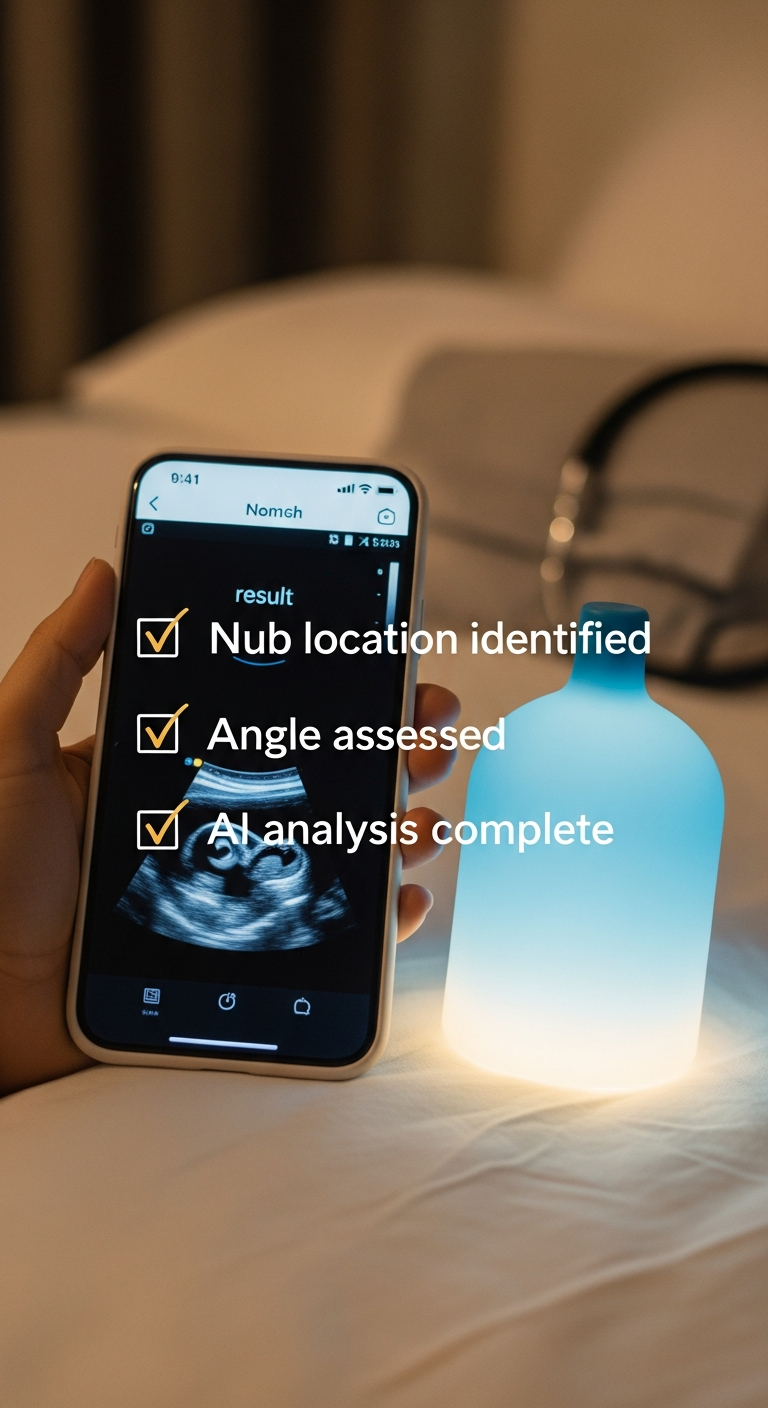
This is where technology changes the game entirely. With an AI tool like NubScan, the process is almost instant:
There's no waiting, no squinting, and no second-guessing. The AI has been trained on thousands of ultrasound images and applies consistent angle measurement every single time — something the human eye simply can't replicate reliably.
What Affects How Quickly You Get a Reliable Result?
Whether you're using AI or doing it manually, a few factors influence how fast and confidently you can reach a conclusion:
- Image clarity — a sharp, high-resolution scan photo produces faster and more accurate results than a blurry photo of a printed scan
- Baby positioning — if the baby wasn't in a perfect side-on position during your scan, you may need to wait for a rescan or try an alternative analysis method
- Gestational age — the nub is most readable between 11+3 and 13+6 weeks; scans taken right at 11 weeks may need re-evaluation a week later for a clearer angle
If you're right at the edge of the optimal window, our step-by-step guide to nub theory at 13 weeks explains how results can actually improve in accuracy as you move through the first trimester.
The Bottom Line on Timing
AI analysis is almost instant. Manual analysis can take considerably longer — and often with less confidence. If you want a quick, clear answer about where the nub is pointing on your 12-week scan, uploading your image to NubScan is by far the most time-efficient route. Most parents have their result — complete with a confidence percentage — before they've even finished their post-scan cup of tea.
Your 12-Week Scan and the Nub: Everything You Need to Know
By now, you have a clear answer to one of the most searched questions in early pregnancy: where is the nub on a 12-week scan. It's the genital tubercle — that tiny bud-like protrusion at the base of your baby's spine — and when viewed in the right sagittal position, its angle tells a surprisingly accurate story about your baby's sex.
Here's a quick recap of everything covered in this guide:
- Location: The nub sits between the baby's legs, at the base of the spine, and is only visible in a sagittal (side-profile) ultrasound view
- What to look for: A small projection pointing either upward (typically a boy) or running flat and parallel to the spine (typically a girl)
- Accuracy: When assessed correctly between 11 and 13 weeks, nub theory can be up to 90–97% accurate
- Timing: AI-powered tools like NubScan can deliver a result in seconds; manual analysis takes considerably longer and introduces more room for error
- Image quality matters: A clear, correctly oriented scan photo is the single biggest factor in getting a reliable nub reading
What to Do Next
If you haven't yet uploaded your scan to NubScan, now is the perfect time. Simply take a clear photo of your 12-week ultrasound, upload it to the app, and receive an AI-generated confidence score in seconds — no guesswork, no squinting, no uncertainty.
Want to sharpen your eye before you analyse your own scan? Browsing through real nub theory examples with annotated ultrasounds is one of the best ways to train yourself to spot the nub quickly and confidently.
And if you're curious about how nub theory stacks up against other early prediction methods, our comparison of nub theory vs skull theory gives you a clear, evidence-based breakdown of which approach is most reliable — and when each one works best.
The bottom line: knowing where the nub is on a 12-week scan gives you access to one of the earliest, most reliable gender prediction methods available before your 20-week anatomy scan. Combine that knowledge with AI-assisted analysis, and you have everything you need to make the most of your first-trimester ultrasound.
Frequently Asked Questions
Where exactly is the nub located on a 12-week scan?
The nub, or genital tubercle, is a small bud-like protrusion located between the baby's legs at the base of the spine. On a 12-week ultrasound, look for a tiny spine-like structure pointing either upward or at an angle — that's the nub used to predict your baby's sex.
How accurate is nub theory at 12 weeks?
Nub theory is most accurate between 11 and 13 weeks. When the nub angle is clearly visible and analyzed correctly, accuracy rates can reach 90–97%. However, fetal positioning, image quality, and sonographer experience all affect reliability.
Can I identify the nub myself from my scan photo?
Yes, with a clear sagittal (side profile) image you can attempt to locate the nub yourself. The nub appears as a small projection near the base of the spine. AI tools like NubScan can help analyze the angle and provide a confidence score to guide your interpretation.
What does an upward vs. flat nub angle mean?
An upward nub angle (greater than 30 degrees relative to the spine) typically suggests a boy, while a nub that runs parallel or flat to the spine often indicates a girl. This angle is the core principle behind nub theory gender prediction.